Water Heater Leak Cleanup in Atkinson, NH
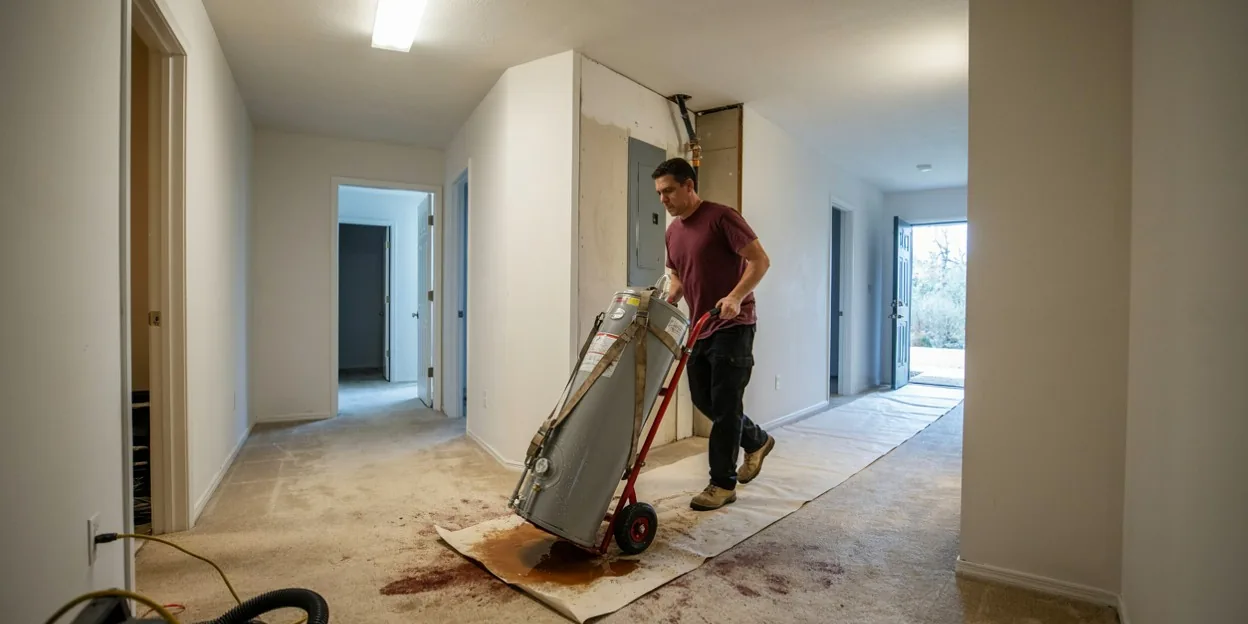
You went down to change the furnace filter and stepped into a puddle spreading out from under the water heater. The tank is eleven years old, there is a rust line around the bottom seam, and the boxes of Christmas decorations next to it are sitting in water. We connect you by phone with an independent local provider who cleans up after a water heater leak in Atkinson and across Rockingham County.
What the crew does first
The crew confirms the tank is isolated. Cold-water valve on top closed, and the breaker off for an electric unit or the gas valve off for a gas one. In an oil-heated house with an indirect tank off the boiler, the boiler loop is shut too. Then they extract the standing water and follow it. A 50 gallon tank does not sound like much until it is on the floor, and a slow leak that ran for days can put far more than that into the slab and the bottom of the finished walls.
A moisture meter on the walls around the tank, the platform it sits on, and the finished side of the basement tells them how far it went. Then air movers and dehumidifiers run until the readings come back down.
What to do in the next hour
Close the cold-water valve on the pipe entering the top of the tank. Flip the breaker for an electric heater, or turn the gas control to off. If the water is coming from the relief valve pipe on the side rather than the tank body, the tank may be sound and the valve may be the problem. Tell the crew.
Move boxes and anything on the basement floor out of the wet area and up onto shelves or the stairs. Take photos of the tank, the puddle, and the rust or drip point. Then make the call. A new heater is a plumber's job. The wet basement is the cleanup crew's job.
What is usually saved and what is not
Bare concrete cleans up fine. Drywall that got wet at the bottom in an unfinished utility area often dries in place. On the finished side of the basement, wet carpet pad, particleboard shelving, and swollen baseboard usually come out. Cardboard boxes that sat in water go, and the crew will help you sort what was inside them.
If the tank was in a first-floor closet, hardwood or laminate outside the door is a maybe. Ask the crew to note readings at the wall bases before and after drying. If water ran across the basement into the finished half, structural drying is the rest of the job.
Rockingham County notes
Most water heaters in Atkinson sit in the basement, which is the right place for them to fail. The slab catches the water, and in an unfinished basement much of it heads for the sump pit on its own. The trouble comes when the basement has been finished and the tank is in a utility room next to a carpeted family room, which describes half the colonials in town. Water goes under the partition wall and into the carpet pad before anyone notices.
Well water changes the tank's life. Hard water and the iron and manganese common in wells around Atkinson, Hampstead, and Danville build sediment in the bottom of the tank, and a tank that is not flushed rusts through from the inside sooner. Many tanks here last eight to twelve years. If the house has a water softener, the tank often lasts longer.
Many policies cover the sudden damage from a tank failure but not the tank itself. A tank that has been dripping for months may be treated as gradual. Ask the crew to photograph the tank, the failure point, and the readings for your adjuster before the plumber hauls the old tank away. Replacing a water heater in Atkinson needs a plumbing permit from the town, and the plumber usually pulls it. If the water reached the sump pit and the pump did not keep up, see sump pump failure cleanup.
Calling about water heater leak cleanup
Say where the tank is: basement, utility closet, or first floor. Say the tank size if you know it, whether the water is off, whether the water reached carpet or a finished room, and whether a plumber is already on the way. Call (603) 665-0909 and tell us what you see.