Water Extraction in Atkinson, NH
You went down to the basement for the laundry and the carpet squished. The washing machine hose let go sometime overnight, and the water has already found the low corner by the furnace and the boxes under the stairs. We connect you by phone with an independent local provider who does water extraction in Atkinson and across Rockingham County.
What the crew does first
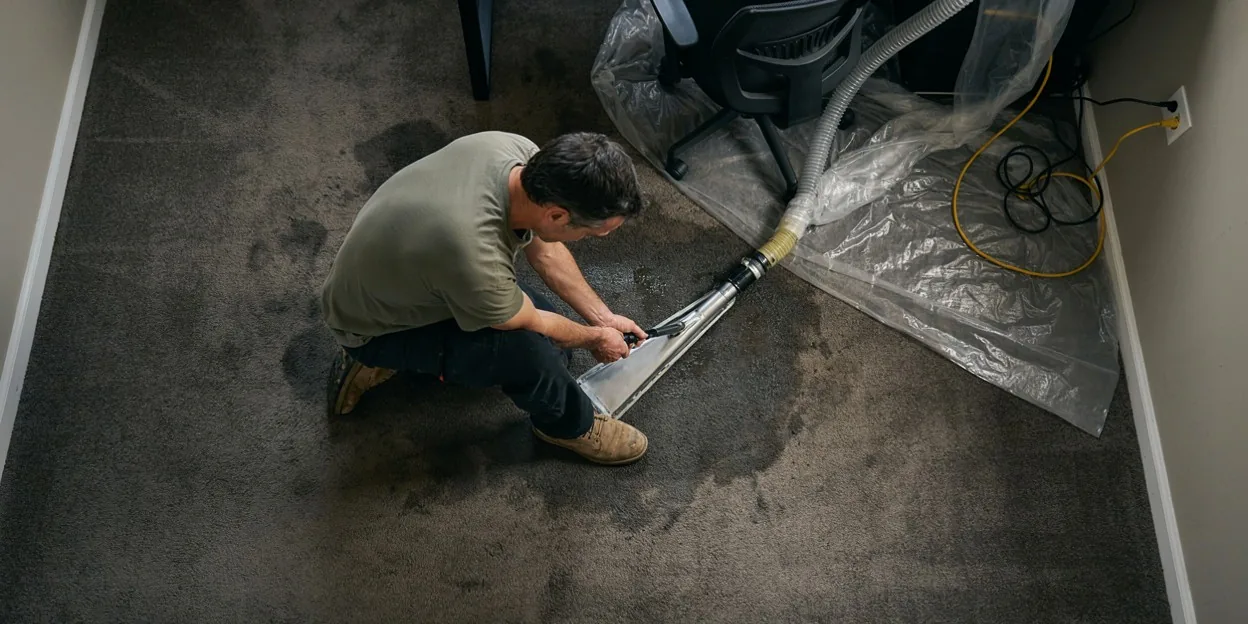
The crew that comes out starts by making sure the water is stopped. If it is not, they will show you the valve or the pump breaker. Then they pump or vacuum the standing water off the floor with truck-mounted or portable extraction units. A shop vac from the garage leaves a lot behind. Extraction gear pulls water up out of carpet pad, out of the grout lines, and off a slab that has no drain.
Once the bulk water is gone, they walk the rooms with a moisture meter. Water in a basement travels under the pad and along the bottom of the finished walls before you see it. Upstairs, it goes under the kick plates and into the subfloor. The readings show where it went. That map decides where drying equipment goes and which materials get pulled.
What to do in the next hour
Shut the water off if you can reach it safely. In an Atkinson house on a well, that is the breaker for the pump and the valve on the pressure tank. On town water in Plaistow or Hampstead, the main valve is where the line comes through the foundation. Do not step into water that has reached an outlet, the furnace, or an appliance cord.
Move what you can lift out of the wet area. Get boxes off the floor and onto the workbench or the stairs. Take photos with your phone before anything is moved or pulled up. Then make the call.
What is usually saved and what is not
Bare concrete and tile clean up fine once the water is out. Solid oak or pine flooring upstairs can often be dried if extraction starts soon, though some cupping is possible. Carpet can sometimes be saved. The pad under it almost never is, and a pad glued to a basement slab is a removal every time.
Laminate flooring, particleboard cabinet bases, and drywall below the water line usually come out. Paneling on furring strips against a foundation wall is a question the meter answers. Ask the crew what reading supports each removal. Extraction is only the first step. Structural drying with air movers and dehumidifiers is what brings the walls and floor back to normal.
Rockingham County notes
Nearly every house in Atkinson, Danville, and Hampstead has a full basement, and that changes extraction. Water on a slab with no floor drain has nowhere to go, so it spreads flat across the whole footprint and wicks up into every wall it touches. If the source was the ground rather than a pipe, the job is basement flooding cleanup, and the crew will want to know whether a sump pit exists and whether the pump ran.
Most homes in town are on private wells, so there is no utility to call for a shutoff. If you cannot find the valve, cut the breaker to the well pump and the water stops within a minute or two as the pressure tank empties. If the water heater is the source, tell the crew, and read about water heater leak cleanup.
Many policies cover sudden water damage from a burst line or a failed hose. Groundwater is often excluded. Ask the crew to document moisture readings and photos so you have them for your adjuster, and to note the source in writing on the first visit.
Calling about water extraction
Know roughly when the water started, and be ready to say which rooms are wet, whether the water is still running, and whether it came from a pipe, an appliance, or the ground. Say if there is standing water right now and whether the basement is finished. Call (603) 665-0909 and tell us what you see.